
Citation with stable link: Philip A. Harland, 'Judeans: Graffito depicting Jesus as a donkey-headed god on a cross (early third century CE),' Ethnic Relations and Migration in the Ancient World, last modified October 24, 2026, https://philipharland.com/Blog/?p=24054.
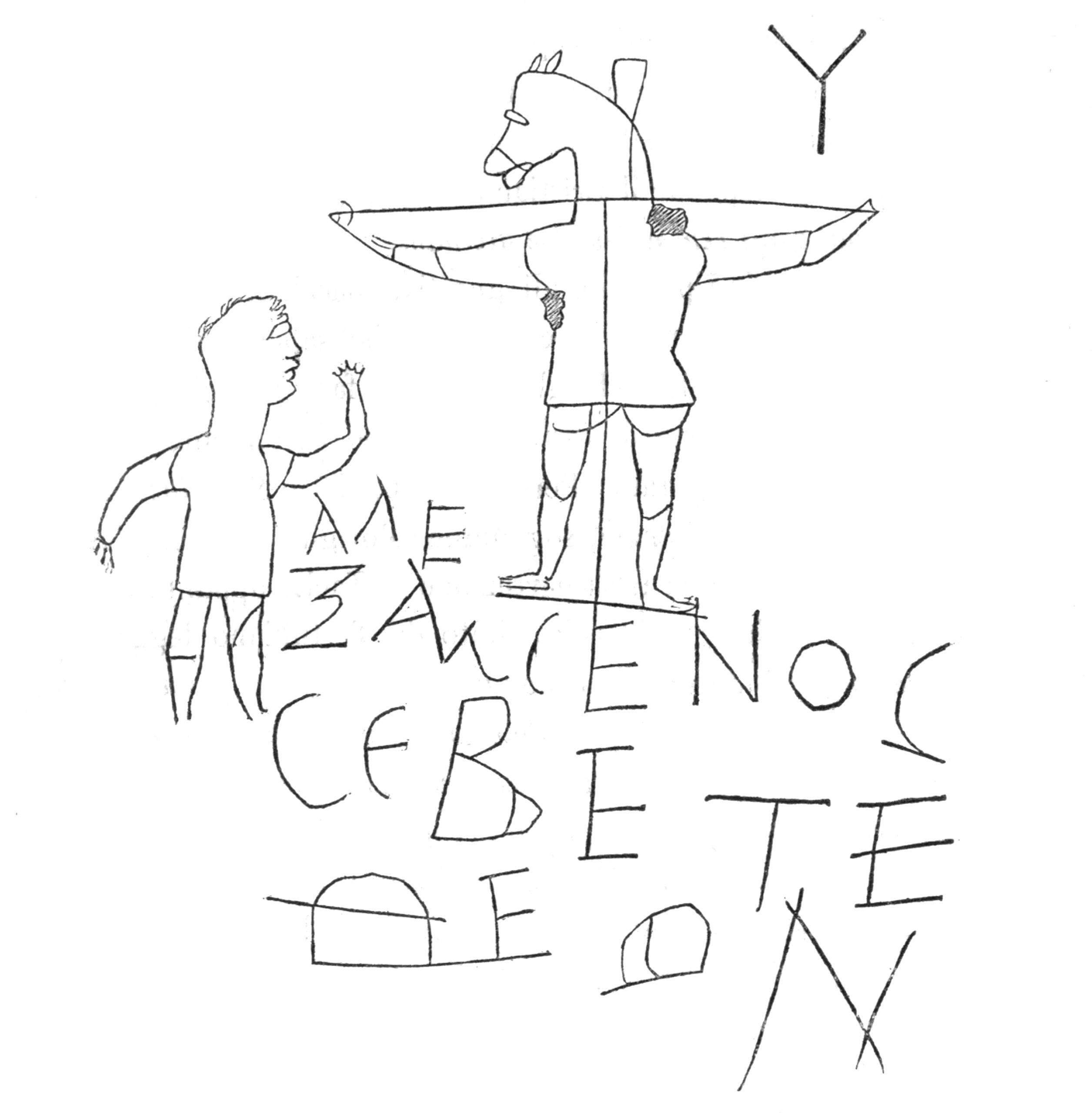
Information and description: This graffito was found scratched onto a wall within a building (paedagogium) on the southwestern slope of the Palatine hill at Rome. The building was frequented by enslaved and ex-enslaved boys and youths (paedogogi or simply pueri) who were likely being trained for various roles in the household of the imperial family, including guiding elite children. Frst published in 1856 and sketched by Raffaele Garrucci (p. 531), the illustration pictures a body from behind in the upper register fastened to a cross-shaped structure as a form of suspended execution, or crucifixion. The figure on the cross is depicted with an anthropomorphic body and a donkey (or, possibly, horse) head. Below is pictured a young male figure (also viewed from behind) wearing the short tunic of an enslaved person (named Alexamenos, we soon learn) who looks up at the other figure and raises his hand toward the executed donkey figure. He is either engaging in the custom of throwing a kiss as a form of honouring a deity or raising a hand in prayerful adoration. Roughly scrawled in Greek between and below the two figures is the phrase “Alexamenos reveres a god” (ΑΛΕ|ΧΑΜΕΝΟΣ | ΣΕΒΕΤΕ | ΘΕΟΝ). That the graffiti artist intended the figure on the cross as an allusion to Jesus, but with a parodic animal head, is not certain without explicit identification. However, the combination of suspended execution with the notion of the criminal being a revered figure, together with the depiction of that figure as a donkey (assuming this is not a horse head), points firmly in no other direction. If this interpretation is correct, then this would be the earliest extant visual depiction of the execution of Jesus, but with a satirical twist. (Description adapted from Harland 2026, 246-247).
Works consulted: R. Garrucci, “Un graffito blasferno nel palazzo dei Cesari.” La Civilta cattolica 7.4 (1856): 529-545; P.A. Harland, Ethnic Relations in the Ancient Mediterranean: Social Life Under Empire (University of Chicago Press, 2026); F. Harley-McGowan, “The Alexamenos Graffito,” in The Reception of Jesus in the First Three Centuries, ed. Chris Keith et al. (T&T Clark, 2019).
Comments: The characterization of Jesus adherents as donkey worshipers and as devotees of a criminal is found in more than one type of evidence. On the one hand, we have upper class Jesus adherents responding to the accusation by outsiders that Jesus adherents were criminals who worshipped someone executed for the ultimate crime of “banditry.” Celsus provides a extensive instance of this form of criminalization (link coming soon). Even more pertinent to our graffito, the character named Caecilius in Minucius Felix’s dialogue (also coincidentally written roughly around the time of our graffito) combines the accusation of worshipping an executed criminal with the notion of worshiping a donkey or donkey head specifically (link). As we know from other evidence, the notion that Judeans (or, by implicaiton, those associated with Judeans like god-fearers or Jesus adherents) would worship a donkey is repeated in several written ethnographic accounts, including Mnaseas of Patara (ca. 200 BCE), Diodoros (mid-first century BCE), Damokritos (likely first century CE), Apion (first century CE) and Tacitus (early second century CE) (link to Josephos’ reactions; link to Tacitus). This specific put-down was also sometimes part of a broader aim of connecting Judeans with Egyptians, picturing Judeans as a subset of Egyptians in other words. Greeks and especially Romans who wanted to denigrate Egyptians sometimes zeroed in on their “animal worship” (e.g. Cicero at link; Juvenal at link; Plutarch at link).
Another very important type of evidence for this ethnographic notion is archeology, and our graffito in particular. This brings us down to the level of the lowest social strata in Rome, in this case, as we witness an enslaved or ex-enslaved individual deploying this ethnographic tidbit about donkey worship together with the notion that Jesus adherents worshipped a criminal. I would not at all suggest that this individual in a training school for the enslaved was reading Mnaseas, Tacitus, or Apion. Rather various characterizations of other peoples, including Judeans, circulated more widely in the population and could come up in a variety of social settings where those from different backgrounds encountered one another. This broader issue regarding ethnographic activity in various social spaces or contact zones is one of the main points of my recent book.
‗‗‗‗‗‗‗
Source of image: Scan from Raffaele Garrucci, “Un graffito blasferno nel palazzo dei Cesari.” La Civilta cattolica 7.4 (1856): 531, public domain.