
Citation with stable link: Philip A. Harland, 'Celts and Ligurians: Roman Senate’s “Trophy of the Alps” and Pliny on peoples conquered by Augustus (7/6 BCE),' Ethnic Relations and Migration in the Ancient World, last modified November 16, 2026, https://philipharland.com/Blog/?p=17738.
Ancient authors: Roman Senate and People, CIL V 78I7 (7/6 BCE), from La Turbie, France (link); Pliny the Elder, Natural History 3.136-137 (mid-first century CE).
Comments: One of the more important sources of archeological information regarding peoples living the Alps in the Roman period is this inscription (the so-called Trophy of the Alps) set up by the Roman Senate and People, crediting Augustus with conquest of 45 peoples, a good number of whom (about 10 or so) are otherwise unknown. Pliny the Elder knows about this monument as well, and he provides a little bit more discussion of peoples in the region. The imperial interest in peoples often pertains to claims of conquest and attempts at control.
‗‗‗‗‗‗‗
Roman Senate
(CIL V 78I7) The Senate and the People of Rome set this up for emperor Caesar Augustus, son of a god, supreme high priest, proclaimed emperor fourteen times, with tribunician power seventeen times, because of his leading and auspices, all the peoples (gentes) of the Alps who reach from the upper sea [i.e. Adriatic] to the lower sea [i.e. Mediterranean] were brought under the control of the People of Rome.
Alpine peoples (gentes) conquered: the Triumpilinians, Camunnians, Venostians, Vennonetians, Isarehians, Breunians, Genaunians, Focunatians; the four peoples of Vindelicians, Cosuanetians, Rucinatians, and Licatians; Catenatians, Ambisontians, Ruguscians, Suanetians, Caluconians, Brixentians, Lepontians, Uberians, Nantuatians, Sedunians, Varagrians, Salassians, Acitavonians, Medullians, Ucennians, Caturigians, Brigianians, Sobiontians, Brodicentians, Nemalonians, Edenatians, Vesubianians, Veaminians, Gallitians, Trizdlatians, Ecdinians, Vergunnians, Eguiturians, Nematurians, Oratellians, Nerusians, Felaunians, and Suetrians.
‗‗‗‗‗‗‗
Imperatori Caesari divi filio Augusto | Pont(ifici) Max(imo) Imp(erator) XIV tr(ibunicia) pot(estate) XVII | senatus populusque R(omanus) | quod eius ductu auspiciisque gentes alpinae omnes quae a mari supero ad inferum || pertinebant sub imperium p(opuli) R(omani) sunt redactae |
gentes alpinae devictae Triumpilini Camunni Venostes Vennonetes Isarchi Breuni Genaunes Focunates | Vindelicorum gentes quattuor Cosuanetes Rucinates Licates Catenates Ambisontes Rugusci Suanetes Calucones | Brixentes Leponiti Uberi Nantuates Seduni Varagri Salassi Acitavones Medulli Ucenni Caturiges Brigiani | Sobionti Brodionti Nemaloni Edenates Vesubiani Veamini Gallitae Triullati Ecdini || Vergunni Eguituri Nematuri Oratelli Nerusi Velauni Suetri.
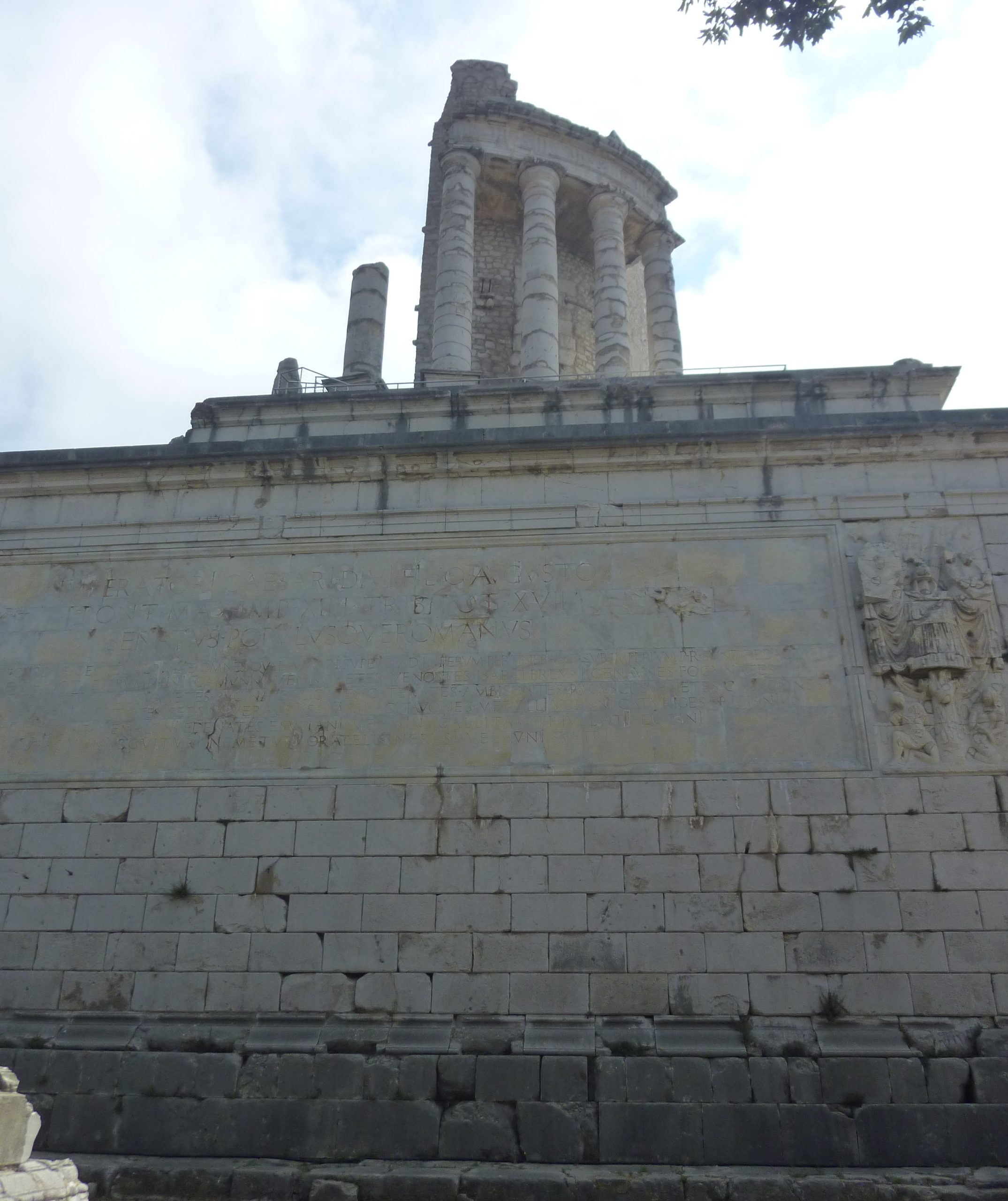
Trophy of the Alps (Miniwark, CC BY-SA 4.0, via Wikimedia Commons)
‗‗‗‗‗‗‗
Pliny the Elder
(Natural History) (3.133) The Alps are inhabited by a great many nations, but the notable ones, between Pola and the district of Tergeste, are: the Fecusses, Subocrinians, Catalians and Menoucalenians, and next to the Carnians the peoples formerly called Tauriscians and now Noricians; adjoining these are the Raetians and Vindelicians. All are divided into a number of communities (civitates). The Raetians are believed to be people of the Etruscan descent group driven out by the Gauls; their leader was named Raetus. Then, on the side of the Alps towards Italy, are the Euganean descent groups having the Latin rights, whose towns listed by Cato number 34. (3.134) Among these are the Trumpilinians, a people that sold themselves together with their lands, and then the Camunnians and a number of similar peoples, assigned to the jurisdiction of the neighbouring municipal towns. Cato before mentioned considers the Lepontians and Salassians to be of Tauriscan origin. But almost all other authors give a Greek interpretation to their name and believe that the Lepontians are descended from companions of Hercules “left behind” because their limbs had been frostbitten in crossing the Alps; and that the inhabitants of the Graian Alps were also Graians from the same band, and that the Euganeians were of specially distinguished family, and took their name from that fact; and that the head of these are the Stoenians. (3.135) The Raetian tribes Vennonians and Sarunetians live near the sources of the river Rhine, and the Lepontian tribe called the Uberians at the source of the Rhone in the same district of the Alps. There are also other native tribes that have received Latin rights; for instance, the Octodurensians and their neighbours the Centronians, the Cottian communities and the Turians of Ligurian descent, the Ligurian Vagiennians and those called the Mountain Ligurians, and several tribes of Long-haired Ligurians on the borders of the Ligurian Sea.
(3.136) It seems not out of place to append here the inscription from the triumphal arch erected in the Alps, which runs as follows:
The Senate and the People of Rome set this up for emperor Caesar Augustus, son of a god, supreme high priest, proclaimed emperor fourteen times, with tribunician power seventeen times, because of his leading and auspices, all the peoples (gentes) of the Alps who reach from the upper sea [i.e. Adriatic] to the lower sea [i.e. Mediterranean] were brought under the control of the People of Rome.
Alpine peoples (gentes) conquered: the Triumpilinians, Camunnians, Venostians, (3.137) Vennonetians, Isarehians, Breunians, Genaunians, Focunatians; the four peoples of Vindelicians, Cosuanetians, Rucinatians, and Licatians; Catenatians, Ambisontians, Ruguscians, Suanetians, Caluconians, Brixentians, Lepontians, Uberians, Nantuatians, Sedunians, Varagrians, Salassians, Acitavonians, Medullians, Ucennians, Caturigians, Brigianians, Sobiontians, Brodicentians, Nemalonians, Edenatians, Vesubianians, Veaminians, Gallitians, Trizdlatians, Ecdinians, Vergunnians, Eguiturians, Nematurians, Oratellians, Nerusians, Felaunians, and Suetrians.
(3.138) This list does not include the 15 communities of the Cottianians which had not shown hostility, nor those that were placed by the Pompeian Law under the jurisdiction of municipal towns. This then is Italy, a land sacred to the gods, and these are the descent groups and towns of its populations.
‗‗‗‗‗‗‗
Source of the translation: H. Rackham, W.H.S. Jones, and D.E. Eichholz, Pliny: Natural History, 10 volumes, LCL (Cambridge, MA: HUP, 1938-1962), public domain (Rackham passed away in 1944, Jones passed away in 1963, copyright not renewed as well), adapted by Harland.